
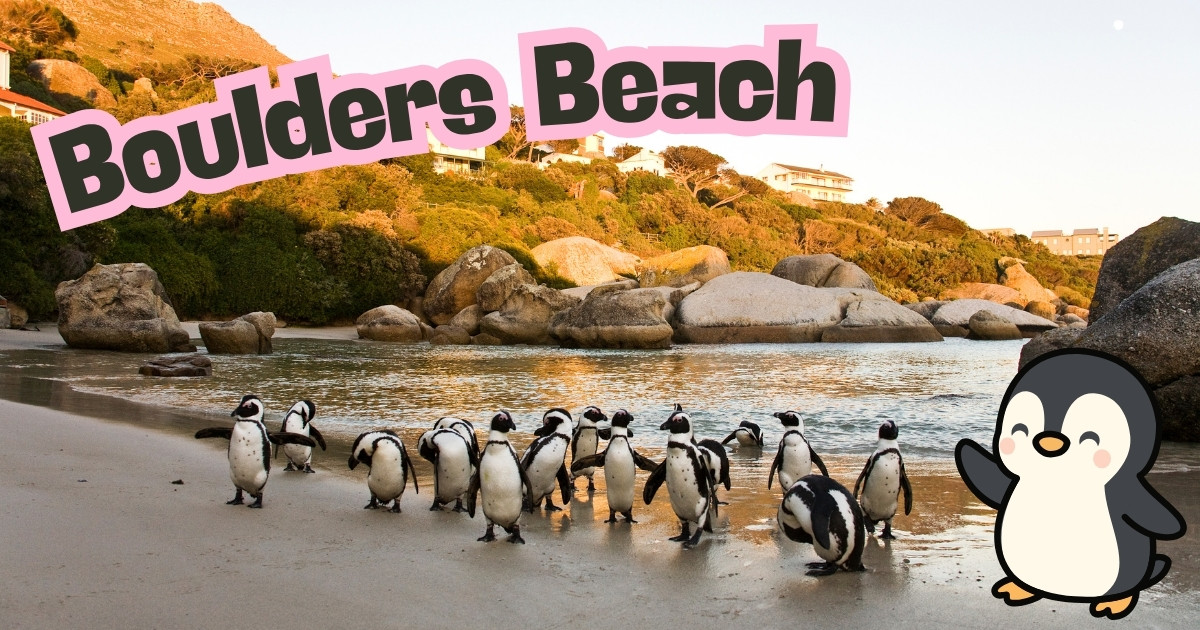
Boulders Beach: Meet the Penguins That Chose Cape Town
There are not many places in the world where you can watch wild penguins waddle past you at arm’s length. There are even fewer where you can do it from a wheelchair.
Boulders Beach, tucked into the naval village of Simon’s Town on the False Bay coast, is one of them. It is one of the only places on Earth where African penguins breed on the mainland rather than on remote offshore islands — and thanks to a well-designed boardwalk system, it is one of the most genuinely accessible wildlife encounters in South Africa.
One of our recent guests, Ron, who travels in a power wheelchair, visited Cape Town with his wife Jean and our guides Pam and Jeff. High winds kept them off Table Mountain that day (the cable car is famously at the mercy of the Cape weather), but Boulders Beach more than made up for it. Watching the penguins go about their business just metres away was, in their words, a highlight of the trip. It usually is.
The penguins that arrived uninvited — and stayed
The remarkable thing about the Boulders colony is how new it is. African penguins have lived along the southern African coast for millennia, but almost always on offshore islands, safe from land predators. Then, in the early 1980s, a handful of penguins did something unusual: they came ashore at Boulders, in the middle of a residential suburb, and started breeding.
According to SANParks, which manages the site as part of Table Mountain National Park, the colony was established in 1983. It grew steadily — helped in part by the reduction of commercial fishing in False Bay, which left more of the pilchards and anchovies penguins depend on — and by 2005 the colony had reached around 3,900 birds. Today it remains one of only a few land-based African penguin colonies in the world, and one of the very few places where the public can observe this bird at close range in a protected natural environment.
If you hear a sound like a donkey braying echoing off the granite boulders, that’s them. The African penguin’s distinctive call earned it the old nickname “jackass penguin” — and once you’ve heard it, you’ll understand why.
A species in serious trouble
Here is the part of the story that makes a visit to Boulders feel less like a photo stop and more like a privilege.
The African penguin is the only penguin species that breeds on the African continent, and it is disappearing fast. When the first full census was conducted in 1956, there were roughly 150,000 breeding pairs. By 2009, that number had fallen to about 26,000 — a loss of more than 80% in just over 50 years. In 2010 the species was reclassified from Vulnerable to Endangered.
In October 2024 came the grimmest milestone yet: the IUCN uplisted the African penguin to Critically Endangered — the first penguin species in the world to carry that status. Fewer than 10,000 breeding pairs now remain across South Africa and Namibia, and conservationists warn that without urgent intervention, the species could be functionally extinct in the wild by 2035.
The pressures are well documented: shortages of the small fish penguins eat, habitat destruction, oil spills and marine pollution, and the effects of a changing climate on fish stocks.
The people fighting for them
The good news is that the African penguin has some formidable allies.
At Boulders itself, SANParks rangers patrol daily, and the beach sits within a no-take zone of the Table Mountain National Park Marine Protected Area, where no marine life may be removed. The conservation fee every visitor pays at the gate goes directly toward protecting the park. The boardwalks themselves are a conservation measure too — they let thousands of visitors enjoy the penguins every day while keeping nesting birds safe from trampling feet and poking fingers.
Beyond the park, SANCCOB (the Southern African Foundation for the Conservation of Coastal Birds) has been rescuing, rehabilitating and releasing seabirds since 1968, and its work with oiled, injured and abandoned penguins and chicks has saved many thousands of birds. In 2025, conservation groups also secured a landmark High Court outcome establishing no-take fishing zones around key African penguin breeding colonies — a major step toward giving the species a fighting chance.
Every visit to Boulders supports this work. It’s wildlife tourism at its best: your presence helps fund the very protection that keeps the colony alive.
How accessible is Boulders Beach really?
We get asked this a lot, and unlike many attractions, the answer here is refreshingly straightforward. This is what SANParks itself says about the site, and what our own guests experience on every visit:
The main penguin viewing area is wheelchair accessible. A well-designed wooden boardwalk allows visitors with mobility impairments to get right down to the penguin colony at Foxy Beach, where raised platforms put you close to the nesting and moulting birds. This is where the famous views come from, and Ron reached it in his power wheelchair without difficulty.
The information centre has ramped access, and wheelchair-accessible toilets are available on site.
A word of honesty about the rest, because we never promise what the terrain can’t deliver: the Willis Walk boardwalk, which links the visitor centre to Boulders’ bathing beach, has a firm surface but is quite steep in places. The concrete ramp down to the beach itself is very steep, and most wheelchair users will need assistance — soft sand beyond it is a further challenge. For most of our guests, the Foxy Beach boardwalk and platforms are where the magic happens anyway; that’s where the penguins are.
A few practical notes worth knowing: parking at Boulders is limited, so arriving early is wise in the peak summer months; a daily conservation fee is payable at the gate (included on our tours); and however endearing the penguins look, don’t touch or feed them — those beaks are razor sharp.
How Boulders fits into our Cape Town tours
Boulders Beach is a signature stop on our Cape Town Highlights tour — 4 nights and 5 days covering the very best of the Cape, with wheelchair-accessible transport throughout and a registered driver-guide at your side.
The penguins star on Day 3, our full-day Cape Peninsula trip: we travel down the coast to the Cape of Good Hope Nature Reserve, stop at Boulders Beach to spend time with the colony, continue to Cape Point for the funicular ride up toward the Old Lighthouse, and return via the spectacular Chapman’s Peak Drive (when open). Entrance fees are included, and because our vehicles and pacing are built around our guests’ needs, there’s no rushing — you take the boardwalk at your own speed and stay with the penguins as long as you like.
Prefer something shorter? Boulders can also be included in our day tours and activities from Cape Town.
Come and meet them while the meeting is good
The African penguin’s future is uncertain. What is certain is that Boulders Beach remains one of the most joyful, most accessible wildlife experiences anywhere in Africa — and that every visitor who rolls or walks down that boardwalk becomes part of the reason it survives.
Enquire now and let us take care of the rest. WhatsApp us on +27 72 585 4127 — we’d love to introduce you to the penguins.