
Why We Always Stop for the Rhino
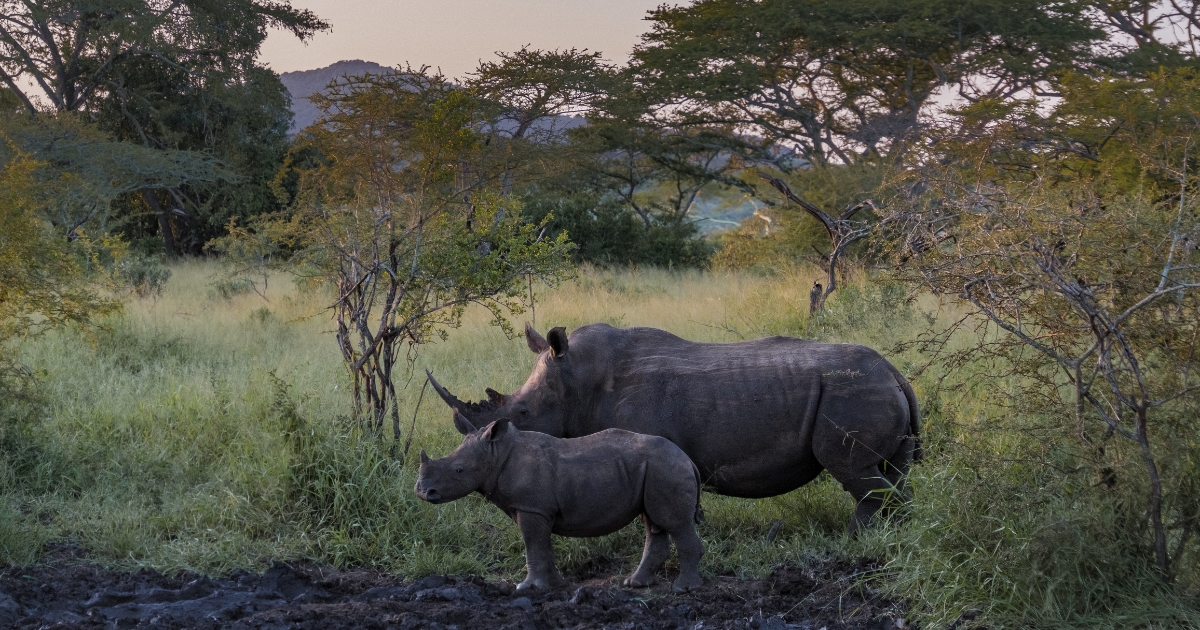
You’ll usually see them before you hear anything about them — a grey shape or two off in the grass, not doing much, just grazing. Our guides will slow the vehicle down anyway. Rhino sightings never really get old for us, and it’s not just because they’re big and impressive to look at. It’s because of what this particular stretch of KwaZulu-Natal actually did for the species.
Hluhluwe-iMfolozi, one of the reserves on our standard KwaZulu-Natal itinerary, is where the southern white rhino nearly disappeared and where it came back from the brink. Twice, as it turns out.
The first time
By the 1890s, hunting had reduced the southern white rhino to a small population along the Mfolozi River — estimates from the period vary, but most put the number somewhere under a hundred animals. In 1895, the area was proclaimed a protected reserve, largely to save them. It’s one of the oldest formal conservation areas in Africa, and for a long time, this handful of rhinos in this one place was the entire global population of the subspecies.
Numbers built slowly. By the 1950s, there were a few hundred, all still in the one reserve, which a ranger named Ian Player saw as a risk in itself — a disease outbreak or a bad drought could undo decades of work in one go. Between 1961 and 1966, his team worked out how to capture and move rhinos safely, something that hadn’t really been done before, and relocated around 500 animals to Kruger, Botswana, Namibia, Zimbabwe, and beyond. Most of the world’s southern white rhinos today are considered descendants of that original iMfolozi population, though nobody’s tracing individual family trees back that far.
The second time
That recovery didn’t hold forever. From around 2008, demand for rhino horn in parts of Asia drove a poaching crisis across the region, and KwaZulu-Natal’s rhino population — one of the densest anywhere — took the brunt of it. More than 300 rhinos were poached in the province in 2023 alone, most of them here.
In 2024, Ezemvelo KZN Wildlife made the call to dehorn the entire rhino population in the park, working with WWF, Save the Rhino International, Wildlife ACT and Peace Parks Foundation. It took about nine weeks. For a while afterwards, poachers started going after the dehorned animals anyway, for the stubs that regrow over time, and the anti-poaching team had to respond to that shift as it happened.
The numbers from last year are the ones we’ve been glad to see: rhino poaching in Hluhluwe-iMfolozi dropped from 198 animals in 2024 to 63 in 2025. Ezemvelo puts that down to more than just the dehorning — better camera and sensor tech in the park, closer coordination with private rhino owners in the province, and tighter checks within the ranger corps all get mentioned alongside it. Poaching also rose sharply in Kruger over the same period, which most people working on this see as pressure shifting to a less-secured park rather than the problem going away.
What you’ll actually see
The reserve holds both white and black rhinos, alongside the rest of the Big Five, across roughly 96,000 hectares — hillier bush in the north, open river valleys further south. White rhinos tend to be in loose family groups, a mother with a nearly grown calf, sometimes a few animals together, grazing with that wide square mouth. Black rhinos are smaller, more solitary, browsers rather than grazers, with a hooked lip, and take more time to find.
If you spot a dehorned one, it looks slightly unfinished — a blunt stub where the horn would curve up.
Our vehicles are set up so guests stay in their own wheelchairs for the drive, and the waterhole hidden in the park can be reached the same way, without transferring out. The same guide travels with you for your whole stay rather than handing you off along the way, which matters more on a multi-day safari than people always expect when going in.
Why is it on our itinerary?
Hluhluwe-iMfolozi is part of our 10-day KwaZulu-Natal safari, alongside iSimangaliso Wetland Park and St Lucia. We include it partly for the wildlife — it’s genuinely good rhino country, and there’s a lot more than rhino to see there — and partly because it’s accessible in a way a lot of reserves still aren’t. Tourism does contribute to the funding behind anti-poaching work in places like this, alongside government security and enforcement, which is worth knowing if you’re weighing up where to spend your time on a trip.
World Rhino Day is September 22, if you’re looking for a reason to plan around. If you’d like to see the park for yourself, get in touch: info@access2africasafaris.com, or WhatsApp us on +27 72 585 4127.