
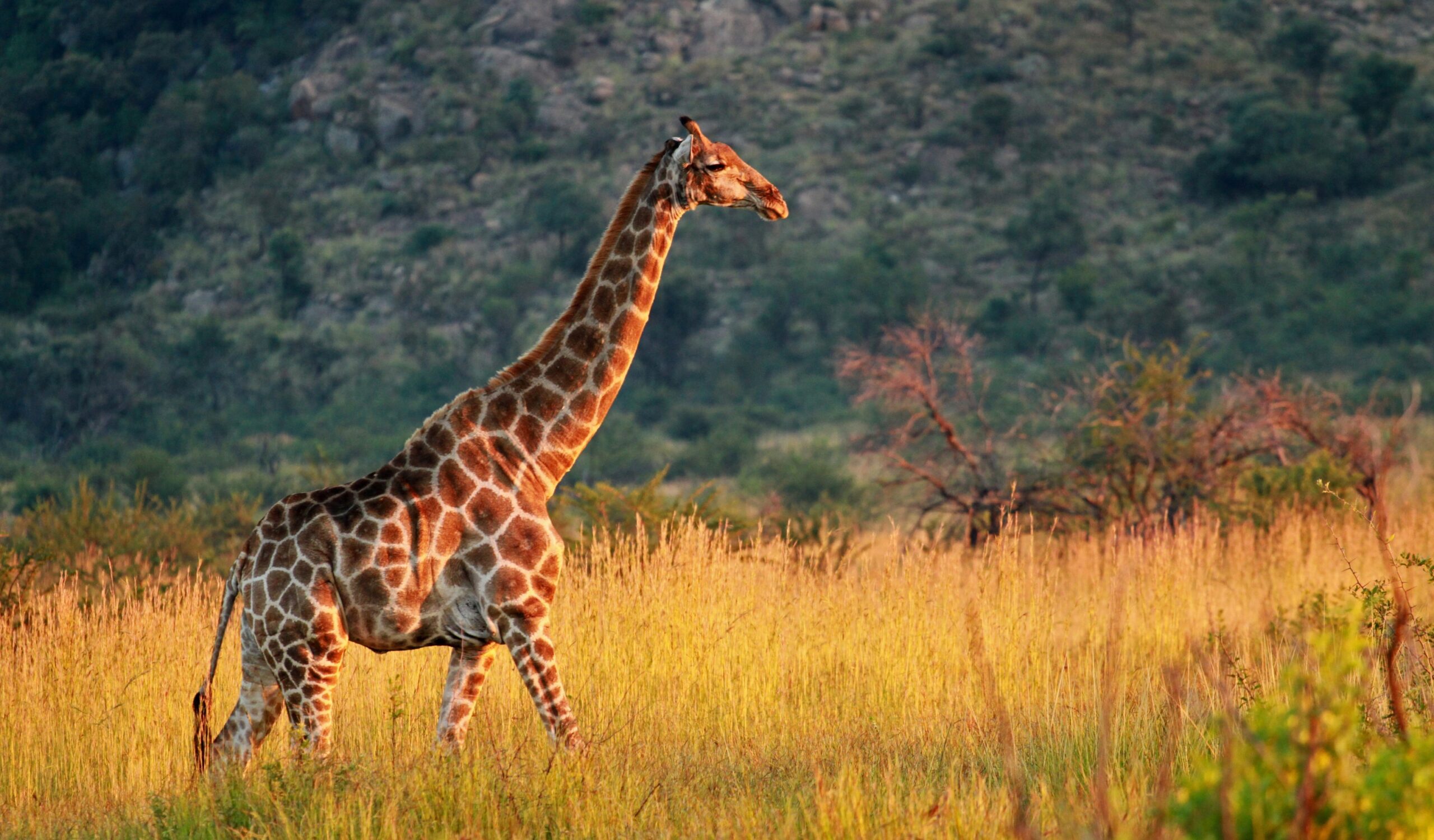
Towers of the Savanna
Few sites in the natural world make you stop in wonder quite like the South African giraffe moving through the thornveld at dawn, their long necks swaying as the amber light of the Lowveld catches their patched flanks. Seeing these majestic creatures in their natural habitat is to truly feel, in some implausible way, that time has slowed down. That you are witnessing a species that time forgot. Something ancient, unhurried, and to a certain degree, not of this modern world.
The South African giraffe (Giraffa camelopardalis giraffa) is one of nine recognised subspecies of giraffe and is native to the southern African countries, with a stronghold rooted in South Africa, Zimbabwe, Mozambique, and Botswana. In South Africa, this subspecies thrives across iconic reserves such as Kruger National Park, Hluhluwe-iMfolozi, and countless private game reserves that bring together the country’s wildlife corridors. They are creatures of the open savanna and woodland, most at home among acacia trees — and for good reason.
EVOLUTION OFFERING A HELPING HAND
The South African giraffe is the world’s tallest living terrestrial animal, with males commonly reaching heights of five to six metres and weighing up to 1,400 kilograms. Their necks alone can measure up to two metres in length, containing the same number of vertebrae as a human neck — just seven, but each bone is dramatically elongated. This extraordinary anatomy is the product of millions of years of natural selection, shaped by competition for food resources that other herbivores simply cannot reach. The uppermost canopy of acacia and combretum trees is the giraffe’s private pantry, accessible to no other large mammal on the savanna.
Their long, prehensile tongues — measuring up to 50 centimetres and coloured a distinctive bluish-black, likely as protection against sunburn — are perfectly engineered to strip leaves from thorny branches without injury. A giraffe can consume up to 45 kilograms of foliage per day, spending the majority of its waking hours in a slow, contemplative browse across the landscape.
A SOCIAL LIFE IN THE THORNVELD
South African giraffes live in loose, open herds with no fixed membership — a social structure researchers call a “fission-fusion” society. Groups form and dissolve fluidly, with individuals drifting between aggregations according to season, resource availability, and social preference. Despite their apparently relaxed social arrangements, giraffes are far from indifferent to one another. Males engage in a behaviour known as “necking” — a ritualised contest in which two bulls swing their necks and land heavy blows with their ossicones (the bony, skin-covered horns atop their heads) to establish dominance. These encounters can be surprisingly violent, occasionally resulting in knockouts, though fatalities are rare.
Female giraffes, or cows, give birth standing up after a gestation period of approximately 15 months. The calf drops nearly two metres to the ground and is on its feet within hours — a necessity in a landscape patrolled by lions, leopards, and spotted hyenas. Even so, calf mortality in the first year of life is estimated to be as high as 50 percent, making the raising of each a precarious undertaking.
Quick Facts — South African Giraffe
- Scientific name: Giraffa camelopardalis giraffa
- Height: Up to 5.5–6 metres (males); 4.5 metres (females)
- Weight: 700–1,400 kg depending on sex
- Lifespan: 20–25 years in the wild; up to 28 in captivity
- IUCN Status: Vulnerable (overall genus); southern subspecies considered more stable
- Diet: Leaves, flowers and fruits of acacia, combretum, and other trees
- Sleep: Only 4–5 hours per night, often in short bursts of minutes
CONSERVATION AND THE SILENT CRISIS
While the South African giraffe is considered one of the more stable of the giraffe subspecies, the broader genus Giraffa has experienced a devastating and largely under-reported decline. Across Africa, giraffe populations have fallen by approximately 30 percent over the past three decades, prompting conservationists to describe the situation as a “silent extinction.” Habitat loss, agricultural encroachment, illegal hunting (or bushmeat poaching), and the effects of civil conflict in parts of their range all contribute to the pressure these animals face.
In South Africa, a combination of protected reserves, private conservation initiatives, and responsible ecotourism has helped maintain — and in some areas grow — local giraffe populations. Organisations such as the Giraffe Conservation Foundation work alongside national parks and game reserves to monitor populations, facilitate translocation of animals to new habitats, and raise public awareness of threats that rarely make front-page news.
AN ICON WORTH PROTECTING
The South African giraffe is a keystone browser whose feeding habits shape the very structure of the woodland it inhabits, creating light gaps that benefit dozens of other species. It is a creature of extraordinary physiological ingenuity, of social complexity, and of an elegance that no photograph ever manages to fully capture.
At Access 2 Africa Safaris, we believe that the wonder of encountering a South African giraffe in the wild should never be out of reach. Whether you have mobility challenges, sensory needs, or any other personal requirements, our team is dedicated to ensuring that every guest can experience these majestic creatures up close — safely, comfortably, and without compromise. From specially adapted vehicles to personalized itineraries built around your needs, we take care of every detail so that nothing stands between you and one of nature’s greatest spectacles. Because some sights — a giraffe moving through the golden thornveld at dawn, its neck reaching for the sky — belong to everyone.